Q&A with LSC Master’s Student Veronica Mingle
Veronica Mingle is a first-year master’s student in the Department of Life Sciences Communication. Originally from Madison, Veronica attended Madison College before transferring to University of Wisconsin–Madison to complete her undergraduate degree, where she earned a minor in LSC. After taking time off to hike the Appalachian Trail, Veronica returned to LSC for her master’s and is excited to start her second semester as a graduate student. She sat down to answer some questions about her experience so far. This interview has been edited for length and clarity.
Q: What are your current project interests?
Because I was born and raised here, I have strong connections to the community. There are two nonprofits in particular that I’m interested in collaborating with.
The first is Brainplate Grows, and I’m applying for a mini grant to support a project called the Bucket Project. First, we collect food scraps from restaurants and use them to create compost-filled buckets. Then, we test different soil ratios—focusing specifically on water retention—to make them as low-maintenance as possible for plant growth. Finally, we place a plant in each bucket and distribute them to low-income families.
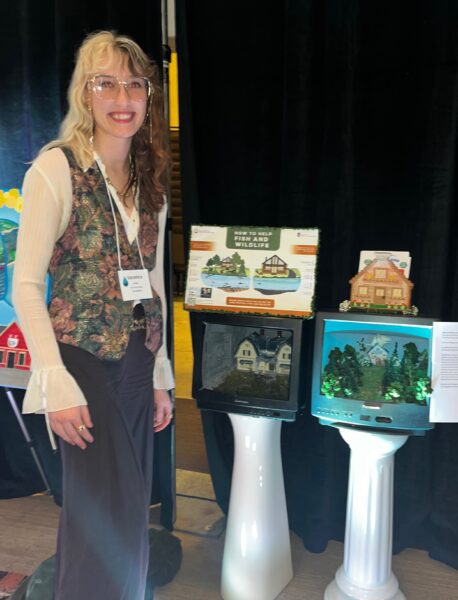
The other nonprofit I’m interested in collaborating with is Clearwater Collective. What they’re doing right now is incredibly exciting, and they’re launching it this summer. The project is called Floating Islands. They use recycled plastic structures filled with native plants that float on bodies of water. As long as the plant roots don’t touch the soil, they can absorb excess nutrient runoff from fertilizers in the water.
More broadly, I’m interested in combating climate anxiety and promoting pro-environmental behavior. How do we make people care? How do we help them feel connected? I like to think of myself as mycelium—connecting everything.
Q: What would you say to someone interested in pursuing the LSC master’s program?
I think it’s a great fit because you can shape it into whatever you want it to be. Many master’s students begin TAing for LSC 100 in their first semester, and it’s an amazing opportunity to be a positive role model while also finding inspiration. Teaching is truly a two-way exchange—while you’re guiding students, you’re also learning from them. Starting the program with that mindset—recognizing both what you can offer and what you can gain—has been really exciting.
I also really value the interdisciplinary nature of LSC. As a culture, we often undervalue the intersections between different fields. Being in a space where I can explore multiple paths and connect ideas across disciplines is incredibly fulfilling. It makes me feel like I still have so much potential ahead of me, which is both motivating and exciting—and something that’s hard to find elsewhere in quite the same way.
Q: What has been your favorite experience with LSC?
I absolutely love teaching. I TA LSC 100, and most of the students are first-year undergraduates. Being in a role where I can share my knowledge while also helping cultivate their excitement about science is really special.
Each person has their own unique strengths, so watching them grow over the course of the semester and develop into their own individuals has been fascinating. I read all their papers, which allows me to get to know them in a way I never have before. As someone with a psychology background, it reinforces how everyone is unique, yet we’re all in this together. That balance between the individual and the collective has been especially rewarding to explore.
Written by: Caitlyn Nalley, LSC Communications Assistant
Published: September 2026