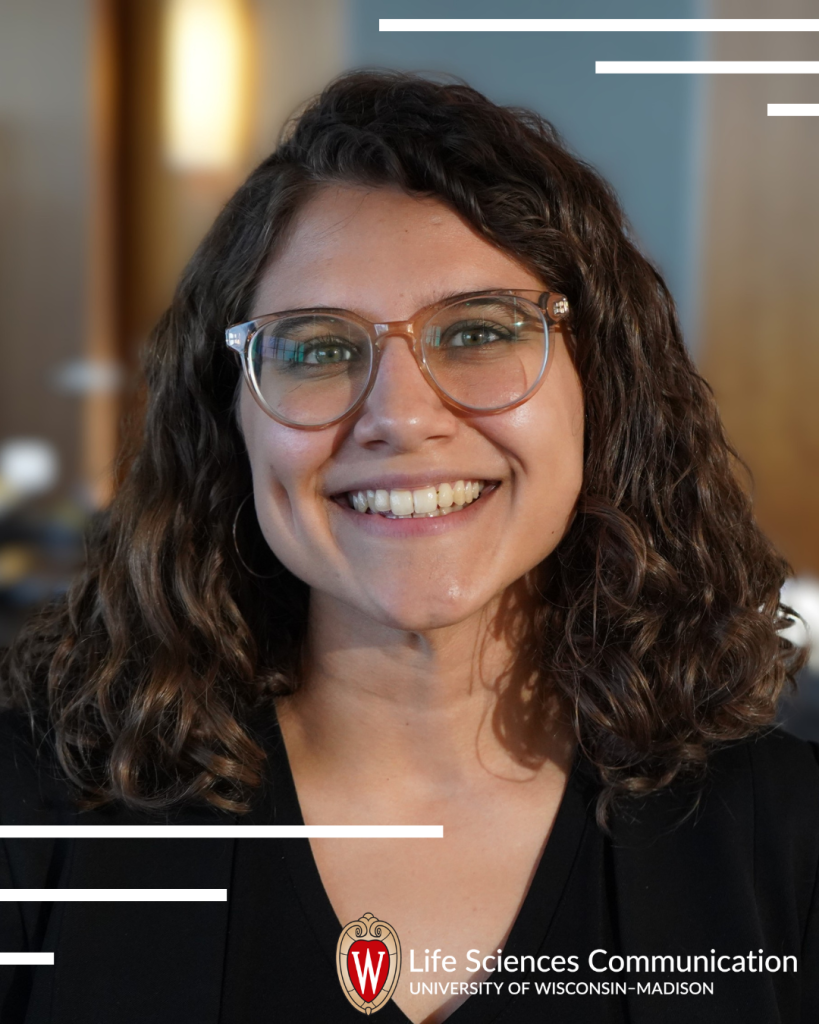
Isabel Villanueva, a PhD candidate within the Department of Life Sciences Communications
Isabel Villanueva, a PhD candidate in the Department of Life Sciences Communication and Research Assistant with the Morgridge Institute’s Sci Lab, shared insights during her final semester on what it’s like to study and conduct research in LSC. Advised by Professor Dietram Scheufele and with dissertation funding from the John Templeton Foundation, Isabel’s research covers the communication of emerging and controversial science issues, as well as how public opinion gets shaped and the role of social media. This interview has been edited for length and clarity.
Q: What are your current research interests?For my dissertation I am studying public opinion on human brain organoids. It’s an emerging technology which uses human stem cells to create three-dimensional models that reflect the early stages of development of the human brain. With others in the department, I’m also studying some of the moral concerns from both the public side and the scientist side.Aside from that dissertation topic, I’m interested in working with people on deliberation. I’ve worked with Dr. Kaiping Chen more on the ground with local nonprofits in Madison to discuss strategies for mitigating the impacts of climate change at the community level. I was involved in projects studying Latino, Black, and low-income communities and the best way to get information to them about climate impacts and extreme heat. We studied how to get them resources about cooling centers and on ways to get involved, like planting trees to create canopies and reduce urban heat. Working directly with people has been something that I’m really interested in pursuing in the future. I kind of want to apply that to brain organoids and other emerging technologies, getting groups together, having small discussions, and picking people’s brains about their concerns.Q: What has been your favorite experience with LSC?I can name a couple. In no particular order, I really enjoyed working directly with people, professors, and working on cognitive interviews with groups in Madison and Wisconsin. I’ve been attending focus groups and talking about the brain organoid survey that I fielded.I think conferences have been really fun too, and I’ve gotten to present my work in a wide array of places as part of LSC. I’m a big conference person. I’ve been to ICA in Denver and Paris. I’ve gone to Public Communication of Science and Technology in Scotland and the Netherlands. I’ve gone to AEJMC in Washington D.C. and Detroit. I really enjoy presenting and being able to talk about my research with others.I also love the flexibility to take classes outside the department. For instance, I did a minor in Music and Educational Psychology. Q: What was your educational journey leading to a PhD in Science Communication?I started my undergrad at Cornell University in Ithaca, New York, where I originally went in as an English major. I didn’t really know what I wanted to do, so I took an array of classes. One of the classes that I ended up taking was Science, Technology, and Politics in the Science and Technology Studies Department my freshman year. I enjoyed that class immensely. After that, I decided to join the major, and the second class I took in the major was Communication, Environment, Science, and Health. I was like, ‘Yeah, this is what I’m really interested in.’ After I graduated, I did my master’s at the University of Arkansas in Communication. I felt like there were a lot of questions left unanswered, so I decided to pursue a PhD in Science Communication. Now I’m here at LSC in the fifth year of my PhD.Q: What advice do you have for those interested in the Science Communication PhD Program?I would say be flexible. When I came into the program, I had a vague idea of what I wanted to do, but that has shifted with the classes that I’ve taken and the research that I’ve done. Be open to different projects and theories to get your toes wet. I said yes to a lot of things, and I quickly learned what I enjoyed and what I wasn’t the biggest fan of.Q: What are you excited for in the future?I am excited about potentially getting a job that is a tenure-track position, but I’m most excited that I don’t know where I am going to be. I could be literally anywhere enjoying the work that I do!I’m also looking forward to teaching more. I didn’t really get the chance to teach much at LSC because I was on fellowship, but I’m excited to work and be more hands on with undergrads in the future.*Isabel recently accepted a full-time position at the University of Miami as an Assistant Professor. We wish her all the best!